
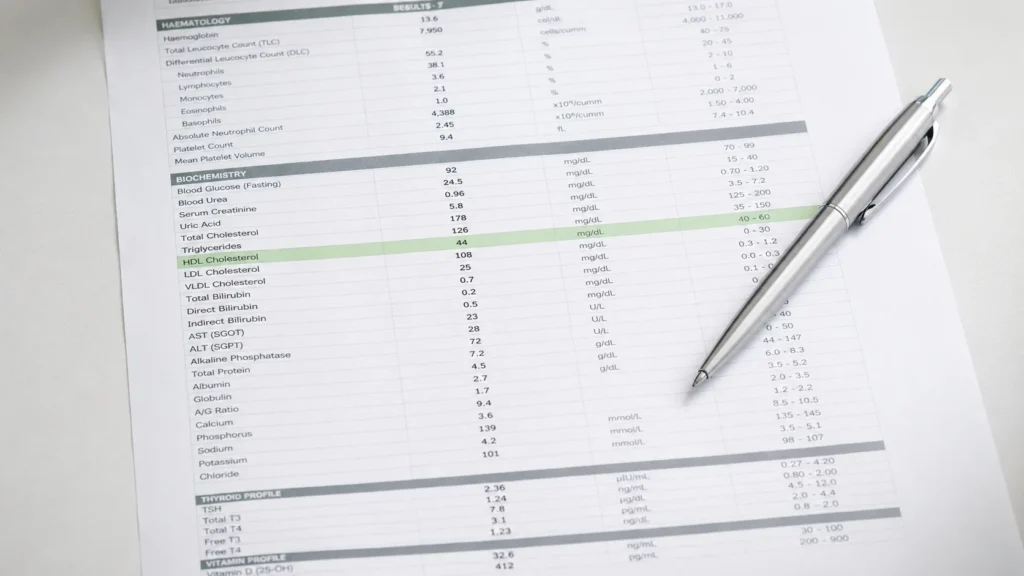
You opened your test report, ran your eye down the columns, and one line was flagged: hs-CRP, with a number higher than the reference range. It is an easy result to worry about, partly because most people have never heard of it until it comes back abnormal. Before you assume the worst, it helps to understand exactly what this marker is measuring and, just as importantly, what it is not.
hs-CRP stands for high-sensitivity C-reactive protein. It is a general signal that inflammation is present in the body. It is sensitive, which is its value, but it is also non-specific, which is its limit. A high number is real information. It is just not, by itself, a diagnosis.
What the number is measuring
C-reactive protein is made by your liver. When there is inflammation anywhere in the body, immune cells release messenger molecules — chief among them a signalling protein called interleukin-6 — and the liver responds by producing more CRP. The “high-sensitivity” version of the test can detect the low, grumbling levels that ordinary CRP tests miss, which is why it is used to assess long-term, low-grade inflammation rather than dramatic acute illness.
Clinicians often read hs-CRP against broad bands used for cardiovascular risk assessment: under 1 mg/L is generally considered low, 1 to 3 mg/L intermediate, and above 3 mg/L higher. Values far above this range usually point to an acute event — an infection, an injury, a flare of something — rather than to a slow background process.
Here is the crucial part. CRP rises for any inflammation. A cold you were fighting on the morning of your blood draw, a recent dental problem, a gym session that left you sore, a healing injury, extra body fat which is itself mildly inflammatory, smoking, or a chronic condition — all of these can lift the number. The test cannot distinguish between them. It tells you the smoke alarm is sounding; it does not tell you which room.
This is why the distinction between acute and chronic elevation matters so much when you read your own result. A very high number is usually the body shouting about something immediate — a throat infection, a wound that is healing, a recent illness — and it will typically settle once that event passes. A mildly raised number that stays raised across repeated tests, taken when you are otherwise well, is the more meaningful finding, because that is the low, steady background inflammation the test was designed to catch. A single reading cannot tell these two situations apart on its own. Only the pattern over time, read together with how you were feeling on each test day, can. This is precisely why doctors are cautious about acting on one hs-CRP value in isolation, and why you should be too.
What the evidence supports
The associations here are reasonably well established. Higher long-term hs-CRP tracks with higher cardiovascular risk at a population level, which is why it is measured alongside cholesterol rather than instead of it. On the other side, the things that lower systemic inflammation are the familiar ones: reducing excess body weight, stopping smoking, improving sleep, and a diet richer in fibre and omega-3 fats. Omega-3 fatty acids, particularly DHA and EPA, are associated with lower inflammatory markers in several studies. For readers who prefer a vegetarian source, the DHA in our Ten-on-Ten range is derived from algae (Schizochytrium), not fish oil.
It is worth being realistic about what these measures achieve. The lifestyle changes that lower inflammation tend to move hs-CRP gradually, over months rather than days, and they work best when several of them are combined rather than pursued one at a time. Losing a little excess weight, sleeping properly and eating more plants and fibre are not exciting interventions, but they act on the actual biology of inflammation rather than masking the marker. Where an intermediate result of 1 to 3 mg/L is found in someone with other risk factors — a family history of heart disease, raised cholesterol, high blood pressure — it can help a doctor decide how firmly to act on those other factors. On its own, though, it changes very little.
What it will not do
A single hs-CRP value will not diagnose your problem, and it will not locate it. It cannot tell heart-related inflammation from a throat infection. One raised reading, especially if you were recently unwell, may simply be noise — which is why a repeat test weeks later, when you are well, is often more informative than the first. Lowering CRP with diet and lifestyle is worthwhile, but chasing the number for its own sake, without understanding the cause, misses the point of the test.
A practical next step
If you were unwell, injured, or fighting an infection near the time of the draw, ask your doctor about repeating the test in two to four weeks when you are back to baseline. Read hs-CRP in context, alongside your lipid profile, blood sugar and blood pressure, not in isolation. And take a persistently raised value to a physician who can decide whether it reflects cardiovascular risk that deserves attention or an active problem that needs finding. The most useful thing you can do with a single flagged result is resist the urge to draw a conclusion from it alone, and instead give your doctor the context they need — how you were feeling, what else is on the report, and what a repeat test shows. The number is a starting question, not a final answer.