
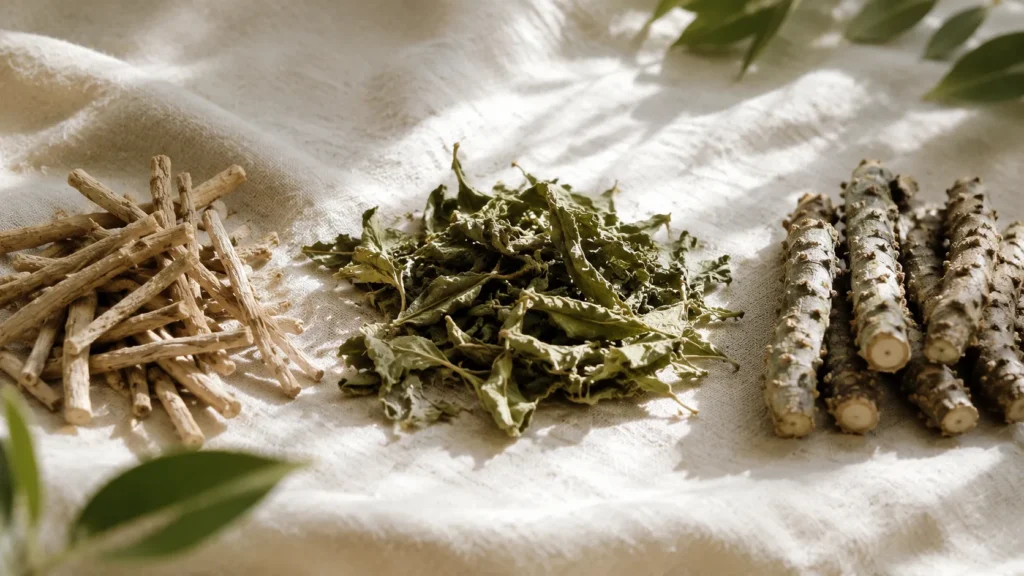
Ashwagandha, Shatavari and Guduchi are three of the most recognisable names in Ayurveda, and you will find all three promoted for a long list of benefits. It is tempting to treat them as a single package of “good-for-you herbs”, but that flattens some very real differences. When you actually look at what the clinical literature supports, these three sit at quite different points on the evidence scale. Knowing where each one stands is the difference between spending your money and attention well, and spending it on tradition alone.
What each herb is understood to do
Ashwagandha (Withania somnifera) is classed as an adaptogen, meaning it is used to help the body cope with stress. Its most studied mechanism involves the stress-response system — the hypothalamic-pituitary-adrenal axis — and in particular the stress hormone cortisol. The idea is that ashwagandha helps modulate an over-active stress response rather than stimulating or sedating you.
Shatavari (Asparagus racemosus) has a long traditional use in women’s health, from reproductive support to its reputation as a galactagogue, meaning something believed to support breast-milk production. It contains plant compounds called saponins, and it is traditionally described as having a nourishing, phytoestrogenic character.
Guduchi (Tinospora cordifolia), also called Giloy, is traditionally used as an immunomodulator — something that adjusts immune activity — and as a general restorative. Its proposed actions centre on influencing immune cell behaviour.
The important word running through all three is modulate. None of these is best understood as a switch that simply turns a system up.
What the evidence actually supports
This is where the three separate. Of the three, ashwagandha has the strongest human evidence. A number of randomised controlled trials have examined standardised root extracts, commonly in the range of 300 to 600 mg per day, for stress, anxiety measures and sleep quality, with generally encouraging results. The evidence here can fairly be described as promising and, in the case of stress and sleep, moving towards strong.
Shatavari sits lower on the scale. Much of its support comes from traditional use and preclinical (laboratory and animal) studies, with limited high-quality human trials to confirm the traditional claims, including the galactagogue reputation. It may well be beneficial, but the honest position is that the clinical evidence is thin.
Guduchi shows interesting immunomodulatory activity in laboratory work, but robust human clinical trials are limited, and it comes with a specific safety note discussed below. So: strong-ish for ashwagandha, largely traditional for shatavari, and preclinically interesting but clinically unproven for guduchi.
There is a further point that the marketing of herbs almost never mentions, and it changes how you should read any claim: the form of the herb matters as much as the herb itself. A trial that showed a benefit used a specific extract, of a specific plant part, at a specific dose — for ashwagandha, usually a concentrated root extract standardised to a set level of active compounds. A cheap powder of the whole plant, or a product that does not say what is inside it, is not the same thing and cannot be assumed to do the same job, even if the name on the label is identical. This is why “does ashwagandha work?” is not quite the right question. The better question is whether this preparation, at this dose, matches what was actually studied. Without that, even a well-evidenced herb becomes a guess.
What it will not do
These herbs are not interchangeable, and none is a general cure-all despite the breadth of their traditional reputations. Ashwagandha’s real evidence is around stress and sleep, not the dozens of unrelated claims made for it. Shatavari’s human evidence is too limited to promise specific outcomes. Guduchi deserves particular caution: because it can stimulate immune activity, it may be unwise in autoimmune conditions, and there have been case reports linking Guduchi/Giloy use with liver injury in some individuals. Ashwagandha is generally best avoided in pregnancy. Traditional use is a reason to investigate a herb, not a guarantee that it is safe or effective for you.
A practical next step
If you are drawn to one of these, match the herb to the evidence and to your actual goal — ashwagandha for stress and sleep has the most to stand on. Quality and standardisation matter a great deal with botanicals, so look for products that specify the plant part and extract used, as our formulations do with their named actives. And if you take regular medication, have an autoimmune condition, are pregnant, or have any liver concern, speak to a doctor before starting, especially with Guduchi. Respect for these herbs includes being honest about their limits.
It is also wise to treat “natural” and “safe” as two separate ideas rather than one. Herbs contain active compounds, and active compounds can interact with medicines. Ashwagandha, for instance, may add to the effect of sedatives or thyroid medication in some people, and anything that modulates the immune system deserves caution alongside immune-suppressing drugs. This is not a reason for fear, but it is a reason to tell your doctor what you are taking, exactly as you would with any other product that has a real effect on the body. The herbs that are worth respecting for their benefits are, by the same logic, worth respecting for their interactions. Used thoughtfully, with the right preparation and a clear goal, these three have a genuine place; used as a vague “good for everything” purchase, they mostly disappoint.