
The phrase “a gut feeling” is older than any science of the microbiome, and it turns out to be more literal than anyone intended. Your gut and your brain are in constant, two-way conversation, and the trillions of microbes living in your intestines are active participants in it. When people notice that their focus is sharper or their mood steadier on some days than others, the state of the gut is one of the genuine, if still-emerging, pieces of that puzzle. This is a fast-moving field, so it deserves both real interest and real caution.
How the gut talks to the brain
There are several channels of communication, and they run in both directions. The most direct is the vagus nerve, a major nerve that connects the gut and the brain and carries signals up as well as down; a large share of its fibres actually report from the gut to the brain rather than the other way around. Alongside it, your gut lining and its resident bacteria produce and influence chemical messengers.
This is where the microbiome earns its place in the story. As gut bacteria ferment the fibre you eat, they produce short-chain fatty acids such as butyrate, which nourish the gut lining, help maintain the gut barrier and are involved in signalling that reaches the brain. Certain gut bacteria are also involved in the metabolism of tryptophan, the raw material the body uses to make serotonin, a messenger closely tied to mood; in fact the great majority of the body’s serotonin is produced in the gut, though its relationship to brain serotonin is more complex than headlines suggest. Some bacteria even produce or influence GABA, a calming messenger.
There is also the inflammation route. A disturbed gut barrier can allow more inflammatory signalling into the body, and inflammation is increasingly linked with low mood and mental fog. So when your microbiome is well fed and balanced, it is contributing calming signals, useful metabolites and a quiet inflammatory tone. When it is disturbed, the conversation it is having with your brain changes.
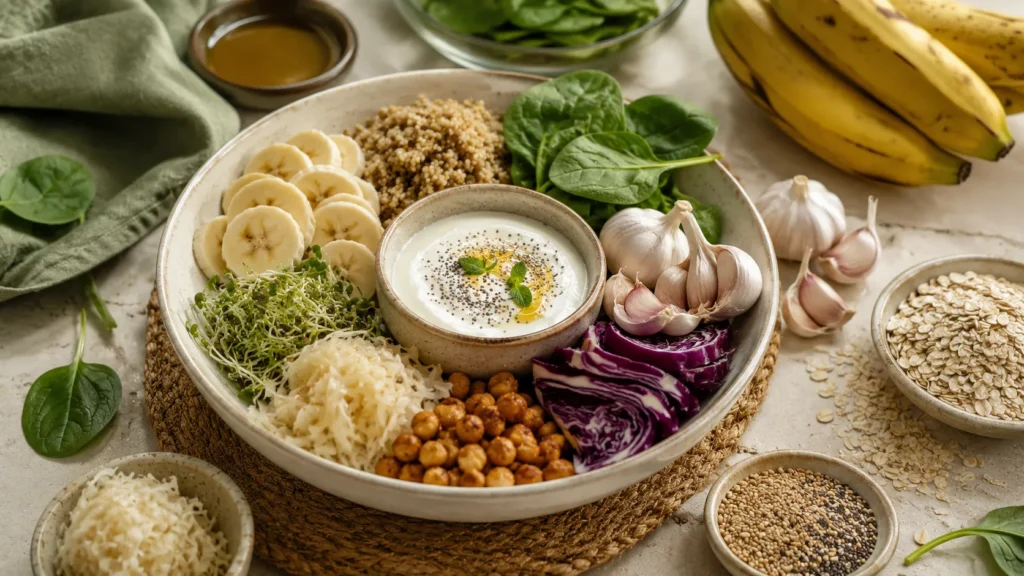
The word “disturbed” is worth unpacking, because it is where diet quietly enters the story. A microbiome that is fed a narrow, low-fibre diet tends to lose diversity: fewer types of bacteria, and fewer of the ones that produce the beneficial short-chain fatty acids. A less diverse community is generally a less resilient one, and this loss of diversity is what researchers often mean when they talk about an imbalanced or dysbiotic gut. The bacteria that thrive are, in a real sense, the ones you feed. Feed them a wide range of plants and fibres and you tend to support a broad, stable community that produces more of the metabolites involved in that gut-to-brain signalling. This is the most concrete link in the whole chain: not that a particular food lifts your mood directly, but that what you eat shapes which microbes flourish, and those microbes are part of the conversation with your brain.
What the evidence supports
The biology of the gut–brain axis is well established. What is still emerging is how far we can deliberately influence mood and focus through the gut. Research on “psychobiotics” — prebiotics and probiotics studied for mental wellbeing — is promising but early, with mixed results and much still to confirm. What is on firmer ground is that feeding beneficial bacteria with prebiotic fibre supports a healthier microbial community. Our SmartyFOS Liquid provides FOS, a prebiotic fibre that preferentially feeds bifidobacteria, and DHA — including the algal DHA in our Ten-on-Ten range — is a recognised structural fat for the brain. These support the terrain; they are not mood medicines.
A large part of why the evidence is still described as “early” comes down to individual variation. Everyone’s microbiome is different — shaped by diet, environment, medication history and much else — so the same probiotic strain or prebiotic fibre can behave differently from one person to the next, and a result that shows up clearly in a group average may be modest or absent for a given individual. This is not a reason to dismiss the field; it is a reason to be honest about it, and to be sceptical of any product that promises a specific, guaranteed effect on your mood or concentration. The reasonable position today is that looking after your gut is a sound thing to do for your overall health, and it may support the systems that influence focus and mood, but the science does not yet let anyone promise a particular mental outcome from a particular capsule.
What it will not do
The gut–brain axis is a real and exciting area, but it is not a treatment route for mental health conditions. No prebiotic, probiotic or supplement will treat depression, anxiety or a diagnosed attention disorder, and none should replace therapy, medication or professional care where those are needed. The science is young, individual responses vary a great deal, and anyone promising that a gut product will fix your mood or focus is running well ahead of the evidence. Improving your gut is a reasonable thing to do for its own sake; treating it as psychiatric care is not.
A practical next step
The most reliable lever is also the least glamorous: feed your microbiome a wide variety of plants and fibre, which supports a diverse, resilient community, and add a prebiotic like FOS gradually if it suits you. If low mood, anxiety or persistent difficulty focusing are affecting your daily life, please treat that as a reason to see a doctor or mental health professional, not something to manage with supplements alone. And if you would rather know than guess about your starting point, our Gut Microbiome panel can show you what your community actually looks like, so any change you make is informed rather than hopeful.